Introduction
Red-Blue Chair, 1917
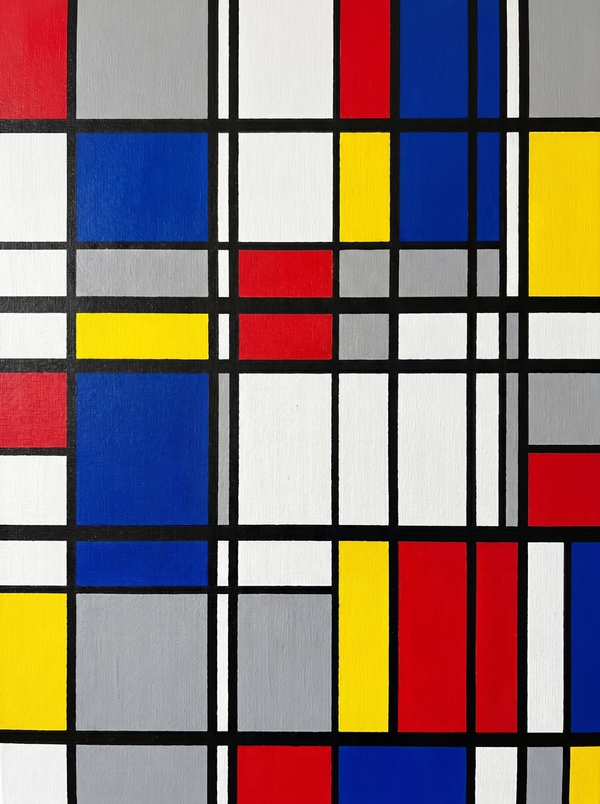
Neoplasticism stands as perhaps the most uncompromising answer to modern disorder ever put forward. Born with De Stijl in 1917, it committed itself entirely to purity and structural order — no exceptions, no compromises. The artist here functions less as an expressive individual and more as an architect: someone building equilibrium rather than recording experience.
The rules were absolute: horizontals/verticals, three primary colors, three non-colors. Neoplasticism rejected nature, emotion, and personal expression.
Definition and Key Works
What makes this movement genuinely interesting is its central idea: beauty emerges through mutual annihilation. Each element cancels its opposite, and what remains is equilibrium. The goal was never to depict the world — it was to construct a closed, self-sufficient organism of balance. A geometric metaphor, if you will, for something approaching cosmic harmony. Three works illustrate this particularly well:
Composition with Red, Blue, and Yellow, 1930
Mondrian’s Composition with Red, Blue and Yellow (1930) arranges color planes within a black grid — a large red square upper left, smaller blue and yellow rectangles lower right. The white areas do something unexpected: they sharpen tension rather than relieve it, and somehow hold the whole thing in balance.
Composition VII, 1924
Van Doesburg’s Counter-Composition VII (1924) introduces the diagonal, which disrupts the spatial logic you’d expect from a Neoplastic work. Lines tilt sharply, generating real energy — yet balance remains. It’s a demonstration that even deliberate departures from the rules can still produce equilibrium.
Composition from the ovoid, 1918
Vantongerloo’s Composition from the Ovoid (1918) arranges color planes in a rigid architectural layout, but the ovoid form introduces a quietly restrained organic quality that offsets the geometry without undermining it.
Artists Who Built the Movement
Three practitioners shaped Neoplasticism:
Piet Mondrian
Piet Mondrian (1872-1944) was something of a geometric mystic. He dismissed diagonals as «tragic» and held firmly that only horizontals and verticals could express universal harmony.
Broadway Boogie Woogie, 1942-43
Theo van Doesburg
Theo van Doesburg (1883–1931), editor of De Stijl, embraced the diagonal, eventually breaking with Mondrian.
Composition in Gray, 1919
Georges Vantongerloo
Georges Vantongerloo (1886-1965) took things further still, extending Neoplastic principles into three-dimensional sculpture.
Composition, 1930
Key Theoretical Texts
The practitioners were, notably, also theorists:
Cover of book «Principles of Neo-Plastic Art» (1925–26)
Van Doesburg’s Principles of Neo-Plastic Art (c. 1925) argues that art attains precision through its own means — color, line, plane — and through cancellation: horizontals cancel verticals, yellow cancels blue.
Cover of book «Plastic Art and Pure Plastic Art» (1937)
Mondrian’s Plastic Art and Pure Plastic Art (1937) went further, proposing that art dissolves into life itself through the vertical (spirit) and the horizontal (matter).
Influences
Three forces shaped Neoplasticism:
Woman with a Crown, 1952
Cubism broke objects into geometric planes; Neoplasticism reduced form to its most elementary components.
Composition VIII, 1923 and Suprematist Composition, 1915-1916
Kandinsky and Malevich had already demonstrated that art need not depend on the visible world.
Thought-Forms, 1910
And Theosophy drew Mondrian toward something deeper — a hidden universal law beneath the surface of chaos, which gave the movement’s formal austerity a distinctly metaphysical weight.
Legacy
What did later movements like Minimalism inherit from Neoplasticism’s language of pure form, grid structure, and equilibrium?
Bauhaus Movement Architettura
The Bauhaus absorbed its principles.
Black Painting, Frank Stella, 1959 and Untitled (Yellow Curve), Ellsworth Kelly, 1982
Minimalism — Stella, Kelly — is its most direct heir.
Rietveld’s Schröder House
Rietveld’s Schröder House translates Neoplastic painting directly into architecture. And its logic, perhaps surprisingly, persists in graphic design and typography to this day.
Conclusion
Neoplasticism is not a conventional style in any ordinary sense. It is a language from which chance has been deliberately excluded. It does not depict life — it proposes a model for it: clear, cool, geometric, held in what the movement’s believers called permanent balance.
Final!
Harrison Ch., Wood P. (eds.) Art in Theory 1900–1990: An Anthology of Changing Ideas. — Oxford: Blackwell Publishers, 1992. — 1189 p.
Doesburg Th. van. Principles of Neo-Plastic Art // Art in Theory 1900–1990: An Anthology of Changing Ideas / ed. by Ch. Harrison, P. Wood. — Oxford: Blackwell Publishers, 1992. — P. 285–289.
Doesburg Th. van. Principles of Neo-Plastic Art // De Stijl. — 1925–1926. — Vol. 6. — № 5/6.
Mondrian P. Plastic Art and Pure Plastic Art // Art in Theory 1900–1990: An Anthology of Changing Ideas / ed. by Ch. Harrison, P. Wood. — Oxford: Blackwell Publishers, 1992. — P. 547–552.
Mondrian P. Plastic Art and Pure Plastic Art. — New York: Wittenborn, Schultz, 1945 (first edition — 1937).
Mondrian P. The New Plastic in Painting // Art in Theory 1900–1990: An Anthology of Changing Ideas / ed. by Ch. Harrison, P. Wood. — Oxford: Blackwell Publishers, 1992. — P. 289–294.
Mondrian P. Le Néo-plasticisme. — Paris: Éditions de l’Effort Moderne, 1920 (German edition: Mondrian P. Neue Gestaltung. — München: Albert Langen, 1925).
Jaffé H. L. C. De Stijl. — London: Thames & Hudson, 1970. — 254 p.
Bax M. Complete Mondrian. — Aldershot: Lund Humphries, 2001. — 620 p.
Troy N. J. The De Stijl Environment. — Cambridge (Mass.): MIT Press, 1983. — 254 p.
De Stijl // Oxford Reference. — URL: https://www.oxfordreference.com (accessed: 02.06.2026).
Mondrian P. Biography // The Art Story Foundation. — URL: https://www.theartstory.org (accessed: 02.06.2026).
Rietveld G. Schröder House // UNESCO World Heritage Convention. — URL: https://whc.unesco.org (accessed: 02.06.2026).
Cover — created by neural network — https://pr-cy.ru/text-generator/
Red-Blue Chair, 1917. Image address: https://www.togas.com/media/wysiwyg/blog/2020/sozdayem-expressivny-interier/mondrian-min.jpg + Website: https://www.togas.com/ru/blog/sozdayem-expressivny-interier?utm_medium=organic&utm_source=yasmartcamera
Composition with Red, Blue, and Yellow, 1930. Image address: https://smarthistory.org/wp-content/uploads/2022/01/1010px-Piet_Mondriaan_1930_-_Mondrian_Composition_II_in_Red_Blue_and_Yellow-870x882.jpeg + Website: https://smarthistory.org/mondrian-composition-ii-in-red-blue-and-yellow/?utm_medium=organic&utm_source=yasmartcamera
Composition VII, 1924. Image address: https://upload.wikimedia.org/wikipedia/commons/c/c6/Theo_van_Doesburg_018.jpg + Website: https://en.wikipedia.org/wiki/File:Theo_van_Doesburg_018.jpg?utm_medium=organic&utm_source=yasmartcamera
Composition from the ovoid, 1918. Image address: https://i.pinimg.com/736x/ce/5b/a4/ce5ba40f6f5e7eab6a9941b7e5557fa7.jpg + Website: https://uk.pinterest.com/pin/georges-vantongerloo-wood-sculpture--185562447139206925/?utm_medium=organic&utm_source=yasmartcamera
Piet Mondrian. Image address: https://i.pinimg.com/236x/c8/ba/24/c8ba249e9774b28c38ab50711c04c36f--primary-colors-february-.jpg + Website: https://www.pinterest.com/cathyrapido/peintres-de-toujours/?utm_medium=organic&utm_source=yasmartcamera
Broadway Boogie Woogie, 1942-43. Image address: https://www.singulart.com/blog/wp-content/uploads/2024/02/Broadway-Boogie-Woogie.jpg + Website: https://www.singulart.com/blog/en/2024/02/04/broadway-boogie-woogie-by-piet-mondrian/?utm_medium=organic&utm_source=yasmartcamera
Theo van Doesburg. Image address: https://i.pinimg.com/736x/32/a0/f9/32a0f9728a2a4c2b652e312e5f69050e.jpg + Website: https://www.pinterest.com/pin/lucia-moholy-18941989-theo-van-doesburg--423127327509067568/?utm_medium=organic&utm_source=yasmartcamera
Composition in Gray, 1919. Image address: https://upload.wikimedia.org/wikipedia/commons/thumb/f/f8/GUGG_Composition_in_Gray_(Rag-time).jpg/500px-GUGG_Composition_in_Gray_(Rag-time).jpg + Website: https://en.wikipedia.org/wiki/Theo_van_Doesburg?utm_medium=organic&utm_source=yasmartcamera
Georges Vantongerloo. Image address: https://media.hauserwirth.com/m/642bed95632c293d/original/Georges-Vantongerloo.jpg + Website: https://www.hauserwirth.com/artists/23358-georges-vantongerloo/?utm_medium=organic&utm_source=yasmartcamera
Composition, 1930. Image address: https://i.pinimg.com/736x/78/5f/bd/785fbdc48436b6039b2cc8b0a2e4d7bf.jpg + Website: https://uk.pinterest.com/pin/constructivism--29554941300629676/?utm_medium=organic&utm_source=yasmartcamera
Cover of book «Principles of Neo-Plastic Art» (1925–26). Image address: https://img.btimages.net/1hw/52157.jpg + Website: https://www.waldenbooks.co.uk/product/sku/52157?utm_medium=organic&utm_source=yasmartcamera
Cover of book «Plastic Art and Pure Plastic Art» (1937). Image address: https://i.pinimg.com/736x/3c/11/23/3c1123cab2e89aa77449cbd37a47a450.jpg + Website: https://ru.pinterest.com/pin/14988611231727766/?utm_medium=organic&utm_source=yasmartcamera
Woman with a Crown, 1952. Image address: https://i.pinimg.com/736x/3c/d2/33/3cd23333f535d7d6ae97c3a0b4d8bbf2.jpg + Website: https://uk.pinterest.com/pin/pablo-picasso-art-cubism--236016836717595029/?utm_medium=organic&utm_source=yasmartcamera
Composition VIII, 1923 and Suprematist Composition, 1915-1916. Image addresses: https://m.media-amazon.com/images/I/81Y80QvtS5L.jpg; https://i.pinimg.com/originals/96/c9/fb/96c9fb5775b5692d1c446b11398d6561.jpg + Websites: https://limpopo.kz/online/374285154723?utm_medium=organic&utm_source=yasmartcamera; https://es.pinterest.com/lunesazules/wallpaper-2023/?utm_medium=organic&utm_source=yasmartcamera
Thought-Forms, 1910. Image address: https://upload.wikimedia.org/wikipedia/commons/0/01/Music_of_Gounod_-Annie_Besant_Thought_Form-_Project_Gutenberg_eText_16269.jpg + Website: https://en.wikipedia.org/wiki/Theosophy_and_visual_arts?utm_medium=organic&utm_source=yasmartcamera
Bauhaus Movement Architettura. Image address: https://i.pinimg.com/736x/c9/e0/44/c9e044c0cb15890cf24e65ded3a1fba6.jpg + Website: https://www.pinterest.com/pin/431923420534022047/?utm_medium=organic&utm_source=yasmartcamera
Black Painting, Frank Stella, 1959 and Untitled (Yellow Curve), Ellsworth Kelly, 1982. Image addresses: https://www.moma.org/d/c/installation_images/W1siZiIsIjM1NTEzNCJdLFsicCIsImNvbnZlcnQiLCItcXVhbGl0eSA5MCAtcmVzaXplIDIwMDB4MjAwMFx1MDAzZSJdXQ.jpg?sha=c333979ae6b342f6; https://i.pinimg.com/736x/88/15/da/8815daa26befc1ea5ef266a29d37c060.jpg + Websites: https://www.moma.org/calendar/exhibitions/2877/installation_images/17546?utm_medium=organic&utm_source=yasmartcamera; https://www.pinterest.com/pin/ellsworth-kelly-orange-lithograph-art-print--91268329930736372/?utm_medium=organic&utm_source=yasmartcamera
Rietveld’s Schröder House. Image address: https://i.pinimg.com/originals/56/0e/5a/560e5a50ab344440a96f8fb3e70c80b4.png + Website: https://www.pinterest.com/pin/gerrit-rietveld-schroder-house--119204721375301781/?utm_medium=organic&utm_source=yasmartcamera